Every page, slide, and ad below runs on a single Big Idea. Cold traffic gets an identity reframe instead of another income promise, and the mechanism flips the order every guru teaches.
The through-line under every piece: "You already know enough. You've just never had a buyer prove it. Get the yes before you build." Proof beat: The Expertise Engine, the system behind $7M+ in student sales; the $27 SLO is its first gear. Webinar title: "Sold Before Built."
The $27 SLO scores the course idea against the market before anything gets built.
Put the offer in front of real buyers while the course is still a plan.
A paying yes is the only validation that counts. Everything else is opinion.
Build last, and only what's already bought. Live Base44 build on the webinar.
How a stranger becomes a buyer: paid traffic in, live webinar in the middle, two close routes out. The close route decision is still open with Will; the deck carries both.
Registration, SLO $27, and Thank You. Two complete design directions, copy audited at Hopkins 91/90.
93 screens, full narrative arc. Route 1 FREE Base44 close as main, route 2 book-a-call scripted as ALT.
35 video scripts + 10 statics, all filtered through Meta 2026 + ASA UK compliance. 28 of the 33 Rivera drafts survived inside them.
Final date, case-study permissions, close route, GHL wiring. The Status tab lists every open item with its owner.
How to review: go tab by tab, open each piece full-screen, and drop feedback in Slack; timestamped notes per tab work best. Anything not flagged in the Status & Next Steps tab is considered locked once you sign off.
Registration, SLO $27, and Thank You, each built in two complete design directions, side by side. Date and time slots are marked as [CONFIRM] placeholders on-page; they lock the moment the webinar schedule is final.
Heads-up on the SLO: the two directions carry two different SLO concepts. Direction A shows the Paper build's "Pre-Sell Script Vault". Direction B implements the July 13 brief: the AI validation tool that scores your course idea. Same $27 price, different product. That decision sits in the Status tab with Will and Guilherme.
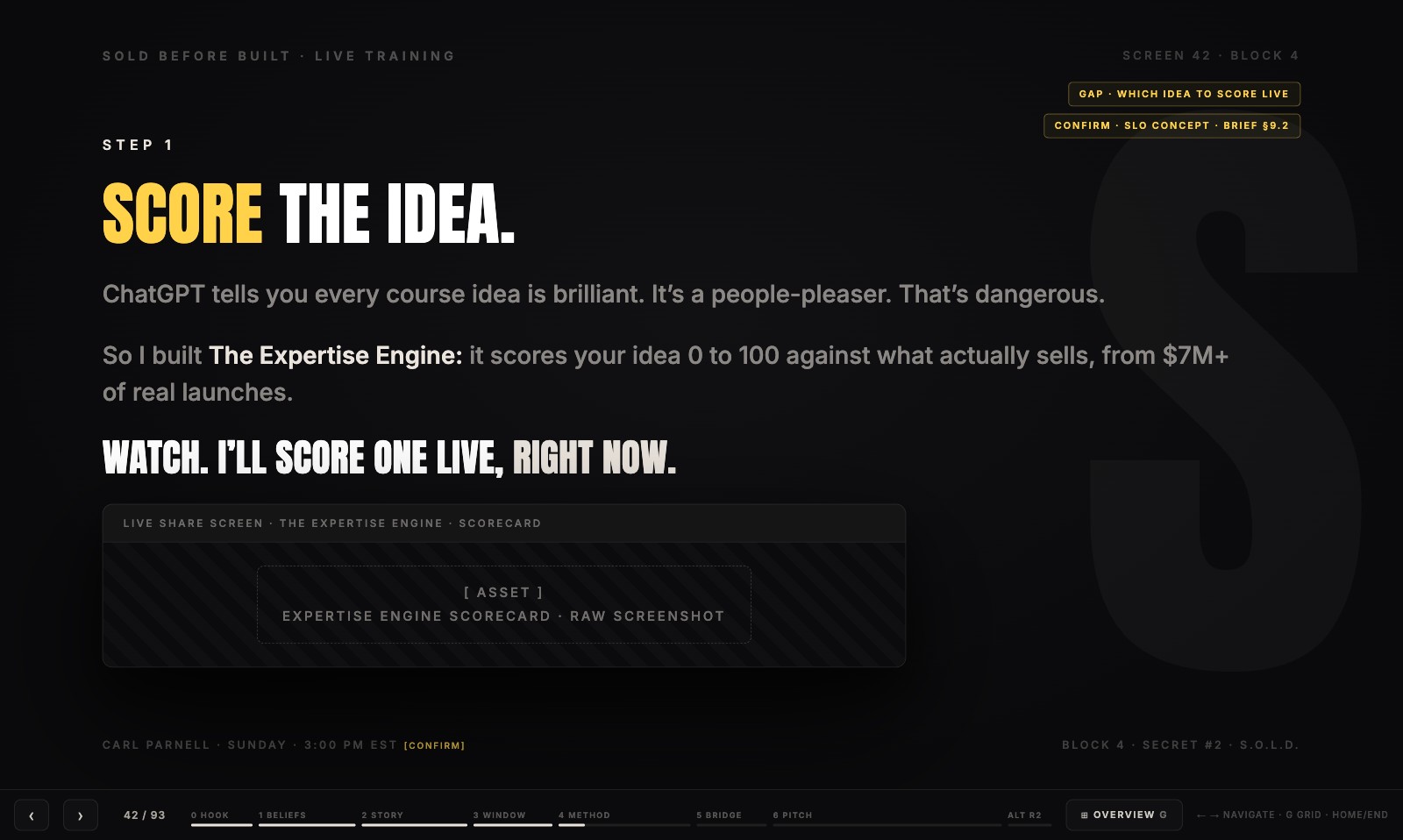
The full "Sold Before Built" training deck: story, mechanism, proof, and both close routes. Best reviewed full-screen with arrow keys.
Route decision pending: the deck carries both closes so the choice with Will doesn't block review. Once route 1 vs route 2 is final, the losing branch and the ON HOLD banners come out in one pass.
35 video scripts (~40s talking head, headline in a black box on top, two hook options per piece with a fixed body) plus 10 static feed ads in 4:5. Every CTA points at the ad button and the free live seat. Button text everywhere: "Save My Free Seat".
Compliance frame: no income promise with a figure and timeframe, no "guaranteed / overnight / anyone can", no "you + your finances". Figures appear only as named, permissioned cases or as aggregate company facts ($7M+ student sales, 1,700+ students, Trustpilot 4.8). Every named case carries "Results shared with permission. Individual results vary." and a [CONFIRM] flag until Carl signs off. 28 of the 33 Rivera drafts survived inside this matrix; 5 fell on income-claim rules.
You were told to record everything, edit it, polish it, and then find buyers.
So the smart ones never start, because who spends two months building a thing nobody's promised to pay for.
Flip it.
You get people to say yes first, then you build the thing they already bought.
Now you're not gambling months on a guess.
You're getting paid to confirm demand.
That one switch is the whole difference between a course that sells and a folder of videos nobody watches.
You've spent years getting genuinely good at one thing.
You can spot the people online who barely know what they're talking about, and they've got the students, the sales, the following.
That's not a talent gap. You're already the expert.
It's a selling gap. They packaged what they know and put it in front of buyers. You never did.
That part is a process, not a personality.
Learn it once and your depth of knowledge stops being wasted and starts being the advantage.
Every expert I know who stalled did the same thing.
They tried to build the perfect course in private, then walked out into silence.
The people who actually launch do it the other way round.
They put a simple offer in front of the right people, get real yeses, and only then sit down to build.
By the time they're recording, it's already paid for.
No guessing. No wasted months. No wondering if anyone wants it, because they already bought it.
Building feels productive, so that's where everyone hides.
Another module, another re-record, another week of polishing a thing no one's bought.
Meanwhile the actual skill, the one that pays, is getting a stranger to hand you money for what you know.
That's the muscle almost no expert trains.
You already have the knowledge. What's missing is the part where someone proves it's worth paying for.
Do that first and the building takes care of itself.
Most course advice has you build for months, launch, and hope.
I do the opposite, and I've taught 1,700 people to do the same.
You sell it before you build it.
You validate the idea with real buyers, take the money, and only then create the thing they paid for.
It's how a beginner starts without gambling, and it's how the system's done over seven million in sales.
That's the entire training. On my screen, live, start to finish.
When every feed is full of AI-written tips from nobody in particular, the one thing that stands out is someone who's actually lived it.
That's you. Years in a real trade, real scars, real judgment a chatbot can't fake.
Buyers can feel the difference, and they're paying for the real version.
The timing's rarely been better to package what you actually know and sell it to people tired of the generic stuff.
The build is what stopped people. Dozens of lessons, editing, the tech, all of it enough to kill the plan before it started.
AI cut that down. Not by doing the thinking for you, it can't, it doesn't know your trade.
It just handles the slow, boring scaffolding once you feed it what you know.
You bring twenty years of expertise. The tools turn it into a structured course in a fraction of the time.
That's why people who never taught anyone are getting it done in weeks.
Every trade has people two steps behind, and they don't want to spend years catching up.
They want the shortcut, and they'll happily pay the person who already walked the road.
That's the whole market. Your knowledge, handed over in a structured way, saving someone else the time and mistakes you ate.
The demand has always been there. What's new is how fast you can package it and how ready people are to buy from a real human instead of a feed of AI advice.
The method's CPD certified, it's done over seven million in student sales, and two of the biggest names in this world stood behind it.
But that's not the part I'm proud of.
It's who it works for. Not gurus. Regular experts. A house cleaner, an architect, a guitarist, a VFX artist who'd never taught a soul.
They took knowledge they already had and turned it into a real business, no ads, no big following.
And the timing to do it has rarely been this good.
My first course went to six figures, then seven, on nothing but Facebook groups and my own profile. No ads.
I built the training for beginners for exactly that reason.
You shouldn't have to gamble money you'd rather keep just to test whether your knowledge sells.
You go to where the right people already are, offer the thing, and let real buyers tell you it works before you spend a thing.
That's the organic side, start to finish.
You know your field cold. People come to your desk when the hard question shows up.
But all that expertise is locked inside a salary and a schedule you don't control.
Here's the part nobody points out. The same knowledge your employer rents from you, other people would buy from you directly.
Packaged into a course, it pays you on your terms instead of theirs.
You don't need a new career. You need to sell the one thing you're already better at than most.
You've built real depth in your field. It shows up in how fast you solve things other people can't.
Right now that only pays you while you're sitting in the chair. Trade the hours, get the hours.
A course flips that. You put what you know into something you build once, and it can sell whether you're at the desk or not.
Same expertise. It just starts working for you instead of only for them.
The building part is faster than it's ever been.
You're good at delivering the work, so the work keeps coming.
But every dollar depends on your time, and you've run out of time to sell.
A house cleaner named Brandon hit that exact wall. He took what he knew about running a cleaning business, put it into a course, and stopped selling only his hours.
He crossed seven hundred thousand in sales doing that.
The knowledge that runs your service is the same knowledge other people in your trade would pay to learn.
Every service business owner sits on a system they built through trial and error.
Other people in your world would pay well to skip the trial and error and just learn your way.
You don't have to drop the service. This runs alongside it.
You package the how, sell it to the people who want it, and now your expertise earns twice from the same knowledge.
One from doing it. One from teaching it.
And the teaching part scales in a way your hours never will.
You went deep on something because you loved it. Ten, fifteen, twenty years of it.
Somewhere in there you got genuinely good, good enough that beginners keep asking you how.
Those beginners are a market. They'd rather pay you for the shortcut than spend years figuring it out like you did.
A guitarist named Ulrich did exactly this. He teaches what he knows and pulls twenty thousand a month while he's out on tour.
The obsession you've funded for years can start funding you.
You assume nobody would pay to learn your niche thing. Usually the opposite is true.
The narrower it is, the fewer people teach it, and the more the right buyers want exactly you.
Rachel Maxwell teaches people how to care for their animals with natural herbs. Not a mass-market topic. She built it to eighty-two thousand a year and moved her family to Costa Rica.
Niche isn't a problem. It's a moat.
If you know your thing deeply, there are people looking for it right now.
When you're deep in a subject, your hardest-won knowledge starts to feel like common sense.
So you assume everyone knows it. They don't.
The things you do on autopilot are the things a beginner would pay to learn, because to them it's a mystery.
Edward Taylor thought this about his VFX work. He'd never taught anyone. He packaged what felt ordinary to him and scaled it to seven figures.
Your "nothing special" is someone else's missing piece.
The story in your head is that only the number one in your field gets to teach it. Not true.
The person who helps a beginner most isn't the world champion. It's someone close enough to remember being stuck where they are.
That's you. A few steps ahead, with the map still fresh.
You don't sell perfection. You sell the shortcut from where they are to where you already got.
An architect, a cleaner, a guitarist all did it, and none of them were the best on earth at their thing.
Look at what those things had in common.
Each one asked you to become a total beginner at something brand new, and most wanted money up front to even test it.
Of course they didn't stick. You were starting from zero every time.
You already have the one asset that actually sells. Years of knowing your subject cold.
You've just never been shown how to package it and put it in front of buyers.
That's a process you were never taught, not a talent you're missing.
You followed the advice. Build it first, make it great, then launch.
You spent weeks recording, you hit publish, and the room was empty.
That's not a sign your knowledge doesn't sell. It's a sign the order was backwards.
You built on a guess instead of getting real buyers to say yes first.
The people who launch to actual sales flip it. They validate and pre-sell before they build, so they already know it works.
Same knowledge. Different order. Completely different result.
The doubt isn't a sign you have nothing to offer. It's a sign you've been close to your subject so long you can't see its value anymore.
Step back. People pay for shortcuts every single day. They pay to skip the years, the mistakes, the dead ends you already went through.
You're not selling yourself as a guru. You're selling the map.
An architect who'd never taught a soul did sixty-five thousand doing exactly that.
The question isn't whether you're worth paying. It's whether you'll package what you already know.
The worry is always the same. It works for other people, but my topic is too specific, too weird, too small.
Look at who's actually done it. A cleaner. An architect. A guitarist. A VFX artist. Someone teaching natural pet care.
Nothing in common on paper. Completely different worlds.
Same process behind all of them, because the process doesn't care what the subject is. It cares that you know it deeply.
If you do, there are buyers for it. The niche was never the problem.
Everyone tells experts to spend two years posting content and growing followers before they're allowed to sell anything.
I did the opposite. My first course sold with no audience, no ads, just my profile and the Facebook groups where the right people already were.
That's the shortcut. You don't build a crowd and hope. You go to where your buyers already gather and offer the thing.
An architect did it with no personal brand at all. Just twenty years of knowing his trade.
The following can come later. The sales don't have to wait for it.
Half the reason experts never start is they picture becoming a content creator. Filming themselves all day, chasing trends, performing.
That's not this.
The organic method runs on quiet, unglamorous stuff. A profile set up right, a group, a few solid posts, real conversations with people who already want your help.
No dancing. No jets. No fake photoshoots in front of a rented Lambo.
I built a seven-figure business without any of that, and I'm about as far from an influencer as it gets.
Most first attempts fail the same way. You built the thing first, in private, then walked out and asked people to buy a finished product they'd never been part of.
Silence isn't a verdict on your expertise. It's a verdict on the order.
Flip it and pre-sell before you build. Get real yeses first, so the thing you make is already wanted before it exists.
The people who do it this way launch to actual sales instead of crickets.
Same knowledge you already have. One change to how you sell it.
It bugs every real expert. Someone with half your depth is out there with students and sales while you sit on everything you know.
It's not knowledge. It's not luck. They didn't start earlier than you.
There's a single move they make right at the beginning, before they build anything, that turns expertise into income.
Almost every expert skips it, and skipping it is exactly why all that knowledge never turns into money.
I'll show you what it is.
Plenty of genuinely great courses never sell a single copy. Plenty of average ones do fine.
The difference isn't what most people think.
There's a single thing you do before you build anything, and getting it right is the line between a launch that pays and one that dies in silence.
It costs nothing and it takes an afternoon.
Almost nobody does it, which is why so many talented experts end up with a folder of videos and no buyers.
Totally different worlds. Different skills, different customers, nothing alike.
Except all three took something they already knew deeply and turned it into a course business, using the exact same process.
The topic changed completely. The steps didn't.
Which quietly answers the question every expert asks first. It's not whether your niche works. It's whether you know your thing well enough to teach it.
If you do, the rest is a system that doesn't care what the subject is.
Most experts start by asking what should go in the course. Wrong question, wrong order.
The question that actually matters comes before any of that. Will someone pay for this, and how do I find out cheaply, before I build a thing.
Answer that first and everything downstream gets simpler. You build what's already wanted instead of guessing.
Skip it and you're pouring weeks into something on a hunch.
The whole game is asking the right question in the right order.
Think about it for a second.
You've charged for your time, your labor, maybe a product. But the deep knowledge underneath all of it, the stuff that took years, you've never actually sold on its own.
It's the most valuable thing you own and the one thing you give away for free in conversations.
Packaged properly, that knowledge is a business. Sold once, over and over, instead of rented by the hour.
Most experts never see it because it's too close to notice.
Paul didn't spend months recording first.
He took what he already knew, put a simple offer in front of the right people, and pre-sold it before building a thing.
Three weeks in, thirty thousand pounds, on a course that still only existed as a plan.
That's the whole point of the method. You get paid to confirm people want it, then you build the thing they already bought.
No gambling months on a guess.
Daniel did it in the order that actually works.
Offer first. Real buyers saying yes first. Money in first.
Only then did he sit down and build the course the buyers had already paid for.
Thirty-six thousand dollars of validation before he ever hit record.
That's the difference between betting weeks on a guess and building something you already know is wanted.
The knowledge was never the missing piece. Kerry already had years of it.
What was missing was a way to sell it without burning ad budget or spending years building an audience first.
The organic route fixed that. The right people, a course built fast, an offer made before the whole thing was finished.
Seven figures from expertise that was already sitting there.
Not a guru. Just someone who knew their subject and finally packaged it.
Nail technicians. That's the niche people would call too small to bother with.
Joanna knew that world inside out, so she taught the people in it how to get more clients.
Thirty thousand pounds in a single month from a topic most would dismiss.
That's the thing about niche. Narrow isn't a weakness. It means the right buyers want exactly you, and there's less noise between you and them.
Your specific thing is probably closer to a business than you think.
Natural care for animals. Sounds like a passion project, not a business.
Rachel knew it deeply, so she turned it into a course and taught the people who wanted it.
Eighty-two thousand pounds a year later, she moved her family to their dream life in Costa Rica.
Same story every time. It's never about how mainstream the topic is. It's about how well you know it and whether you package it.
The thing you love and know cold might be the most sellable thing you own.
You know more about your subject than half the people charging for it. They packaged what they know and got paid. You never did. That part is a process, and I'll show it to you live and free this week.
Most course advice has you build for months, launch, and hope. I do it the other way round. You validate and pre-sell first, take the money, then build the thing people already bought. Live and free this week.
When every feed is generic AI advice from nobody in particular, the one thing that stands out is someone who's genuinely lived it. Buyers can feel the difference, and they're paying for the real version. Live training this week.
Totally different worlds, one shared move: they took what they already knew and turned it into a course business. The process doesn't care what your topic is. It cares that you know it deeply. I'll break it down live and free this week.
You don't have to become an influencer, film reels, or perform for an algorithm to sell what you know. The organic method runs on quiet, unglamorous stuff. A profile, a group, real conversations. Live and free this week.
Different people, different topics, one process. Package what you already know, sell it organically, no ads, build it fast. I'm walking through the whole framework live this week, step by step.
Most experts build the whole course first, then walk out into silence. Flip it. Get real buyers to say yes before you build, so you already know it sells. That one switch is the difference between a launch that pays and one that dies quiet. Live this week.
The method's CPD certified and it's done over seven million in student sales. But the part I'm proud of is who it works for. Regular experts, not gurus. I'm showing how a beginner starts, live and free this week.
Narrow isn't a weakness. The tighter your niche, the fewer people teach it and the more the right buyers want exactly you. Joanna knew nail-tech marketing cold and taught it. I'll show you how, live and free this week. Results shared with permission. Individual results vary.
You don't need a finished course, an audience, or an ad budget. You need one buyer to say yes before you build a thing. That's the whole shift, and it's the entire free training. Live this week, on my screen, start to finish.
Left column is built and ready for sign-off. Right column is every open item, grouped by owner, so nothing waits on the wrong desk.